
This article is part of our complete guide: The Complete Guide to Content Marketing for Small Businesses in Ireland.
Local Content Marketing for Small Businesses: How to Attract Nearby Customers Through Targeted Content
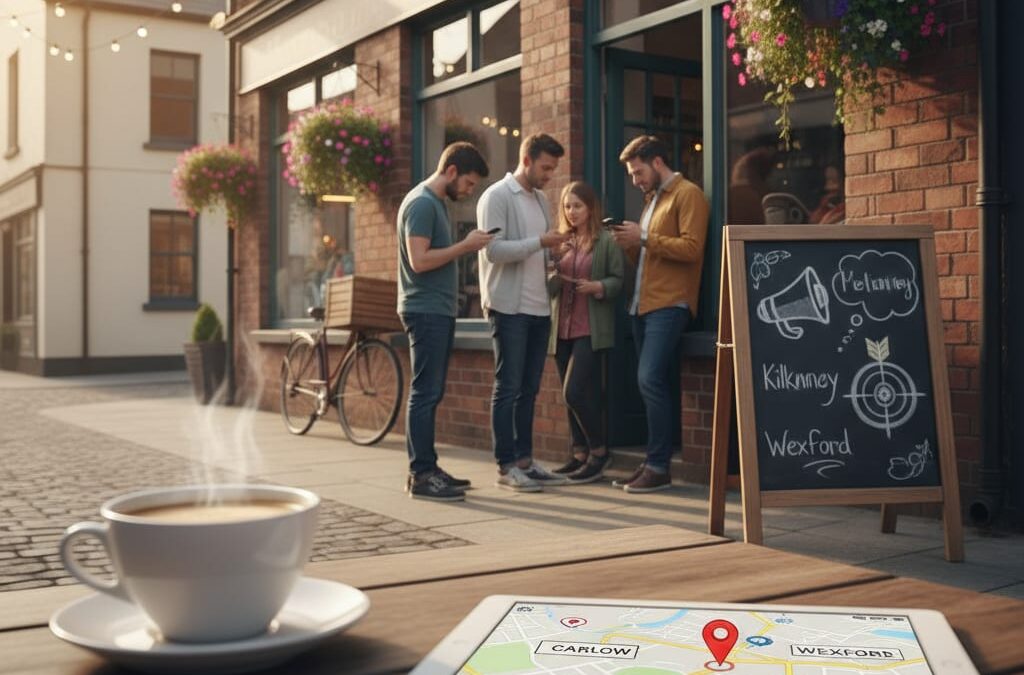
Most small business owners know they should be “doing content.” But generic blog posts about industry trends won’t bring a customer through your door in Carlow, Kilkenny, or Wexford. Local content marketing does something different – it connects your business to the specific people searching for services in your area, right now.
This article walks you through what local content marketing actually looks like in practice, and how to use it to drive real enquiries from nearby customers.
—
What Is Local Content Marketing and Why Does It Matter for Small Businesses?
Local content marketing means creating content that speaks directly to your geographic audience – their questions, their area, their needs – rather than trying to reach everyone on the internet at once.
For small businesses, this is a significant advantage. You’re not competing with national brands for broad keywords. You’re showing up for searches like “best accountant in Portlaoise” or “wedding florist near Kilkenny” – searches where a local business should win, if the content is there to support it.
According to Google, 46% of all searches have local intent. That’s nearly half of all searches where someone is looking for something nearby. If your website isn’t producing locally-focused content, you’re invisible for a large slice of genuinely ready-to-buy queries.
—
What Kind of Content Actually Attracts Local Customers?
The most effective local content answers the questions your nearby customers are already asking – it’s not about writing for search engines, it’s about writing for people in your community.
Here are the formats that consistently work for Irish SMEs:
Location-specific service pages If you serve multiple towns, create a dedicated page for each. A web design agency in Carlow serving clients in Wicklow, Wexford, and Kilkenny should have a page for each location – not one generic “areas we serve” page. Each page should include local references, specific services relevant to that market, and a clear call to action.
“Near me” blog posts Write posts that answer real local questions: “What to look for when hiring a bookkeeper in Carlow,” or “5 things Kilkenny restaurants should know before building a website.” These aren’t clickbait – they answer genuine questions from people who are likely close to making a decision.
Local guides and roundups Content that helps your community – like a guide to local business grants in County Carlow, or a roundup of the best markets in Wexford – builds trust and earns links from other local sites. It positions you as a business that’s genuinely invested in the area, not just selling to it.
Case studies featuring local clients “How a Carlow-based café increased online orders by 40% after redesigning their website” is far more compelling to a nearby business owner than a generic success story. If a client gives you permission, name the town, describe the challenge, and show the outcome in specific terms.
—
How Do You Optimise Local Content for Search?
Good local content needs to be findable – which means combining strong writing with basic local SEO principles.
A few things that make a real difference:
- Use the town or county name naturally in your headings, page title, and first paragraph. Don’t force it, but don’t avoid it either. “Web design services in Carlow” is a legitimate heading that helps Google understand what the page is about.
- Include your Google Business Profile. Keep it updated with your address, opening hours, and recent posts. Link to your content from it where possible.
- Get listed in local directories. The Irish Times business listings, Golden Pages, and local chamber of commerce directories all count. Consistent NAP (name, address, phone number) across these sites strengthens your local search presence.
- Ask for Google reviews that mention your location. A review that says “best web designer in Carlow” is more valuable for local SEO than a generic five-star rating.
- Use schema markup. If your site runs on WordPress or a similar CMS, a plugin like Yoast or Rank Math can help you add LocalBusiness schema – structured data that tells Google exactly where you operate and what you do.
—
How Often Should You Publish Local Content?
Consistency matters more than volume – one well-researched local article per month will outperform four rushed posts published in a panic.
For most small businesses, a realistic content schedule looks like this:
| Business Type | Suggested Frequency | Content Mix |
|---|---|---|
| Service business (e.g., accountant, solicitor) | 1 article per month | Local guides, FAQs, case studies |
| Retail or e-commerce | 2 articles per month | Product spotlights, seasonal guides, local events |
| Hospitality (café, hotel, restaurant) | 2-4 posts per month | Local food stories, events, behind-the-scenes |
| Trades (builder, electrician, plumber) | 1 article per month | Project showcases, local tips, regulatory updates |
The key is to publish something that’s genuinely useful to a local reader, not something that just fills space on a website.
—
FAQ: Local Content Marketing for Small Businesses
Do I need a blog to do local content marketing? Not necessarily. Location-specific service pages, your Google Business Profile posts, and local case studies all count as local content. A blog helps, but it’s not the only option.
How long does it take to see results from local content? Most businesses see measurable improvements in local search rankings within three to six months of publishing consistent, locally-focused content. It’s not instant, but it compounds – older content continues to rank and attract traffic long after you’ve published it.
What if I serve multiple counties – how do I handle that? Create a dedicated page for each area you serve. Each page should have unique content that speaks to that specific location – don’t just copy and paste with the town name swapped. Google penalises duplicate content, and local readers will notice the lack of genuine relevance.
Is local content marketing worth it if I already run Google Ads? Yes. Paid ads stop working the moment you stop paying. Local content builds organic visibility that doesn’t disappear when you pause your budget. The two approaches work well together – ads drive immediate traffic while content builds long-term presence.
Can I use the Trading Online Voucher to invest in content marketing? The Trading Online Voucher (TOV), administered through your Local Enterprise Office, can fund digital marketing activity including content creation and SEO as part of a broader website or digital strategy project. It’s worth checking with your local LEO for the current eligibility criteria, as the scheme is updated periodically.
—
The Bottom Line
Local content marketing for small businesses isn’t about writing for the sake of it. It’s about making sure that when someone nearby searches for what you offer, your business is the one they find.
Start with what you know: your location, your customers’ real questions, and the specific services you provide. Build content around those things, publish it consistently, and the visibility follows.
If you want help developing a local content strategy that’s built around your business and your market, get in touch with the Yourweb team. We work with small businesses across Ireland to build websites and content strategies that actually bring in customers.
—
This article is part of Yourweb’s Complete Guide to Content Marketing for Small Businesses in Ireland.